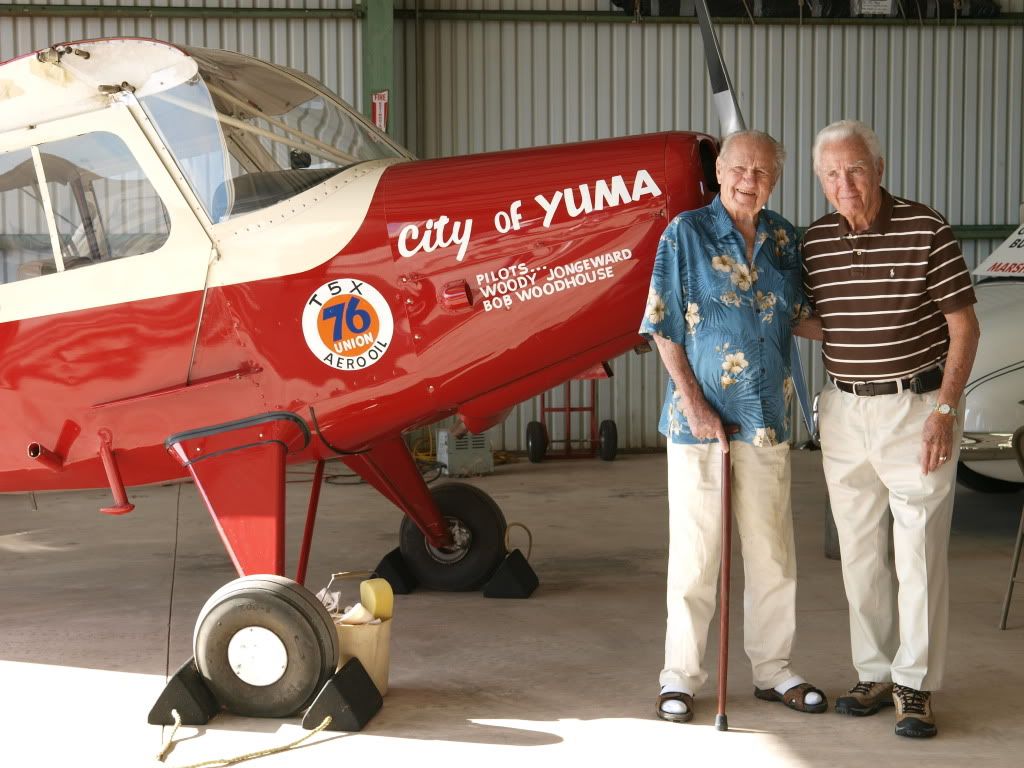
Interesting article in the Yuma newspaper about what if they tried the endurance flight today.
~~~~~
Could endurance flight take place in current era?
October 10, 2009 12:17 PM
BY TERRY ROSS, SUN NEWS AND INFORMATION CENTER DIRECTOR
One of the disappointing things that happened to my father, and probably a lot of other "shade tree" do-it-yourself mechanics, was the computerization of automobiles.
Prior to the installation of these onboard computers - designed to improve fuel efficiency, reduce pollution and monitor the various systems - vehicles were mostly mechanical. You know, you took a part out and you replaced it with a new one.
That's still true to some extent, but the heart of the vehicle - its engine and fuel systems - is usually much more technologically sophisticated these days. It is harder to flip the hood up in your driveway and start fixing or tuning up things - you need specialized computer readers to find out what is going on.
Prior to that, someone with a mechanical inclination and a basic knowledge of automobiles - perhaps fortified with some auto repair manuals - could actually do a lot to repair or modify their vehicles.
I was thinking about this as I read an article we published this week about the modifications made to the City of Yuma, the airplane used in 1949 to set a flight endurance record of 47 days here. The event was celebrated Saturday.
I was wondering if this would have been as easy today.
I am sure airplanes, like automobiles, have become more sophisticated and complicated over the years. It likely is not as easy to "jury-rig" modifications as it was in 1949.
Of course, the modifications on the airplane were supervised by Paul Birch, a well-respected member of the local aviation community who met an untimely death some three decades ago when an airplane crashed into a hangar at the airport. He was the head mechanic at Marsh Aviation in 1949 and was a key figure in making the endurance flight possible.
So the comparison probably isn't quite the same, but still it appears the 1948 Aeronca Sedan AC-15 airplane used in the flight was pretty basic and therefore easy to modify.
It was chosen in part for the flight because it had a large cabin to provide the space needed to install two auxiliary fuel tanks once seats were removed, said Yuma author James Gillaspie.
Gillaspie co-authored a book on the flight with Shirley Woodhouse Murdock, sister of one of the pilots, Bob Woodhouse. The other pilot was Woody Jongeward. Gillaspie also spearheaded the effort to find and return the historic plane to Yuma in the 1990s.
He recounted to the Yuma Sun the modifications made to the airplane. Once the extra tanks were installed in the cabin, a way had to be found to transfer the fuel to the main wink tank. This was done with a hand-operated pump installed in the cabin.
Depending on which way one of the pilots cranked the pump, they could put fuel in the auxiliary tanks from small cans handed up to the plane from a speeding car underneath the plane or transfer fuel from the extra tanks to the wing tank.
Another significant modification, Gillaspie noted, was the ability to change the engine oil in midflight, which was changed every 100 hours of flight. Oil lines were installed from the engine to the cabin so new oil flowed into the engine as old oil flowed out another hose.
Various other mechanical modifications were made, as well as adding needed control panel gauges to the rather rudimentary aircraft.
I find the idea of fueling and changing oil while in flight with the engine always running to be fascinating. It demonstrates the kind of determination and ingenuity necessary to accomplish the record-breaking flight.
It also underlines the risky nature of this venture. Handling fuel is inherently dangerous - imagine doing it from cans over and over again as the engine continued to run.
And transferring fuel and other items from a car to the airplane as they raced along together nearly touching each other repeatedly day after day is equally as dangerous.
Would something like this even be possible today? Could a group of community people get together and do something so spectacular and hazardous?
I can just hear all the arguments about insurance and the potential for getting sued if something went wrong and how it was just too dangerous.
It was a different era in 1949. World War II had recently been won. People thought big. They could get together and say, "Let's do it!" And there weren't a lot of "nannies" hanging around saying, "Hey, someone could get hurt!"
http://www.yumasun.com/opinion/fuel-534 ... s-one.html