Building a ground plane - for a radio
-
john-ranger

- Posts: 111
- Joined: Sat Jul 12, 2008 00:33
- Location: Henderson, NV
- Contact:
Building a ground plane - for a radio
Joe A. has mentioned before about the importance of a ground plane. I'm breaking down and buying a "real" aircraft radio (ICOM A200....used). The question is how & where to install the ground plane. I'm thinking of installing the antennae on the bottom of the aircraft. Any ideas about where to install & how to install the ground plane? Also the location of the antennae. Is it important?

John,
Several choices here. You can mount it on the bottom of the engine cowl and use the cowl for the ground plane.
You can as well mount it on the top of the fuselage and make a ground plane inside the fabric, or I have seen some mount it on the aluminum gap seal covers between the wing and fuselage and use them.
Also have seen a really neat version inside the tailcone that used some screen wire for the ground plane and kept the antenna inside and thus no drag.
There are many ways to do this, so experiment and see what works best. Personally I do not like the antenna on the cowl as its too close to the mags and is somewhat directional. Hope that others chime in here and we get some good ideas.
My Chief had a aluminum plate inside the fabric on the upper part of the fuselage and the antenna was mounted to this. It worked very well with my handheld.
Make sure that you ground everything and make it work as a unit.
Joe A
Several choices here. You can mount it on the bottom of the engine cowl and use the cowl for the ground plane.
You can as well mount it on the top of the fuselage and make a ground plane inside the fabric, or I have seen some mount it on the aluminum gap seal covers between the wing and fuselage and use them.
Also have seen a really neat version inside the tailcone that used some screen wire for the ground plane and kept the antenna inside and thus no drag.
There are many ways to do this, so experiment and see what works best. Personally I do not like the antenna on the cowl as its too close to the mags and is somewhat directional. Hope that others chime in here and we get some good ideas.
My Chief had a aluminum plate inside the fabric on the upper part of the fuselage and the antenna was mounted to this. It worked very well with my handheld.
Make sure that you ground everything and make it work as a unit.
Joe A
-
john-ranger
- Posts: 111
- Joined: Sat Jul 12, 2008 00:33
- Location: Henderson, NV
- Contact:
Fast answer is, no it does not have to be exposed. That said, the more you surround it with metal, my gut feeling is that it will not be as effective but then I did not stay in an Express Holiday Inn last night and am not an electrical engineer or avionics guy.john-ranger wrote:Does the antennae have to be exposed to the outside?? I would love to avoid having anything showing from the outside if possible.
Putting it inside the rear of the fuselage has worked well in the past. Never have seen one inside the wing, so lets see. Each one has its limitations. Installed in the rear of the fuselage when you are head on to the transmitting station my gut tells me that the signal might not be as good as when you are 90 degrees to the station.
-
Nathan K. Hammond

- Posts: 2371
- Joined: Wed Nov 17, 2004 00:22
- Location: Danville, KY (DVK)
- Contact:
Generally speaking, one square foot of aluminum is the the minimum for a ground plane. More is better.
If you don't mind the anntenna showing; placing in the wing root faring will give a nice ground plane, and exceptional line of sight. Not to mention, it can be installed with relative ease.
Placing the antenna inside the fuselage is fine, but you could lose some overall performance because of the tubing. The trick is getting back into the fuselage to install a ground plane.
nkh
If you don't mind the anntenna showing; placing in the wing root faring will give a nice ground plane, and exceptional line of sight. Not to mention, it can be installed with relative ease.
Placing the antenna inside the fuselage is fine, but you could lose some overall performance because of the tubing. The trick is getting back into the fuselage to install a ground plane.
nkh
7AC-5691
Super 85-12F @ DVK
Super 85-12F @ DVK
-
Nathan K. Hammond
- Posts: 2371
- Joined: Wed Nov 17, 2004 00:22
- Location: Danville, KY (DVK)
- Contact:
Never have. Comm antenna are usually clocked 12/6; up and down. Nav antenna are 3/9 or left right; remember the vertical fin on early Citabria's.
What I was told; Comm freqs modulate up and down, and Nav freqs move left and right. That may be total BS though... I'm not the guy to answer that.
nkh
What I was told; Comm freqs modulate up and down, and Nav freqs move left and right. That may be total BS though... I'm not the guy to answer that.
nkh
7AC-5691
Super 85-12F @ DVK
Super 85-12F @ DVK
-
Captgrumps
- Posts: 790
- Joined: Tue Jan 17, 2006 20:18
- Location: Georgia GA10/OPN
- Contact:
-
Carl Prather
- Posts: 234
- Joined: Thu Dec 30, 2004 11:21
- Contact:
Antennas
Here is the website for inside antennas. The word around my parts is that these antennas work well. I know fellow put one on yard stick and tied the stick to the tubular fuselage of his biplane. He was happy with the results. Maybe someone on the list has some direct experience to share.
http://www.advancedaircraft.com/
http://www.advancedaircraft.com/
From the site above. Looks interesting...
~~~~~
FAQs
Q. What cable length is recommended for the antenna ?
A. Any length can be used. This antenna is impedance matched to 50 ohms to allow you to use any length required.
Q. Can I use it in the plastic or fiberglass wingtip of a metal airplane ?
A. Yes, but the antenna must be as far from the metal wing as possible. We have had limited success with this. Not recommended for the RV series aircraft.
Q. Will the strobes cause interference ?
A. It is possible to couple the strobe audio squeal into the VHF radio. This
happens when the antenna is close (about a foot) to the strobe.
Q. I thought the com antenna has to be vertical to work.
A. For maximum sensitivity, this is best. The VHF-5 antenna has a higher gain than others but still when mounted in the horizontal plane the resultant sensitivity is reduced but useable.
Q. Can I mount the antenna on a metal part of my airframe?
A. No ! This antenna works best when separated from all large metal objects. Mounting it on any metal destroys its antenna properties.
Q. Some people have good operation with a ground plane working with their antenna, does this one do the same?
A. No, any ground plane will destroy the effectiveness of this antenna.
Q. My fabric airframe is completed, where is the best location for the antenna?
A. Mount it on a wood brace in the fuselage behind the cockpit. Fasten one end to a location on the lower part of the fuselage frame corner. Then fasten the other end to the opposite or diagonal part of the inside of the upper frame corner. Fasten the antenna to this installed piece of wood.
Q. Should I be careful of the angles at which I mount this wood?
A. No. As long as the antenna is in the same plane as the plane of rotation of your propeller, it'll work.
Q. What happens if I mount the antenna on one of my wood stringers on the fuselage?
A. The maximum range will always be off to the sides and the minimum range will be ahead and behind you.
Q. What happens if I mount the antenna on my wood spar in the wing?
A. The maximum range will always be ahead and behind you and the minimum range will off to the sides.
Q. What if the antenna has to be mounted with a bend to fit in the space I want to use?
A. Curving the antenna will fill in those minimum range areas mentioned above at the slight expense of the maximum range.
Q. Can't I have both?
A. No, only a fixed amount of energy can be radiated. If you redirect energy to fill in holes in the pattern you must remove some from one part of the radiation pattern to fill in the other.
Q. Why is it so long compared to others?
A. This is a dipole which is half wave length long and makes it about twice as long as quarter wave antennas.
Q. Can this be made shorter ?
A. No, it must be used as manufactured. If it is cut to fit, it will be destroyed.
Q. Do I need a 337 ?
A. Perhaps. This is between you, your IA, and the local FAA. It mounts inside and so does not alter the airflow, it attaches with adhesive so no holes or alterations are required for the airframe mount, and it is too light weight to affect weight and balance.
Q. Will this work on my canopy?
A. Yes, but keep it as far from the metal frame as practical.
Q. Why do I have to keep it away from metal things?
A. Any metal alters the characteristics of the tuning and pattern in unpredictable ways. Each airframe installation is different, so we recommend that you use tape and experiment with locations until you are satisfied with the operation.
Q. Where is a good location in my fiberglass fuselage?
A. Put the com antennas on either side in the tail cone, & if the fuselage isn't tall enough bend the antennas to resemble the letter"C". If you are using two, stagger them on opposite sides and try to have about 24 inches or more in the stagger.
Q. Why haven't I seen this type of antenna previously?
A. This design has been in operation since 1981 but in response to consumer demand they are now being produced for the non-metal airframe market.
DIAGRAMS
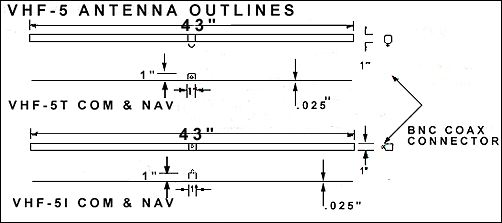
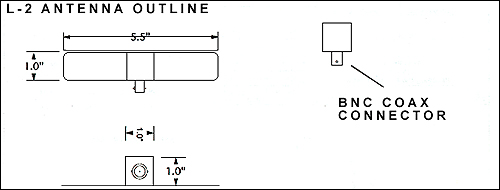
~~~~~
FAQs
Q. What cable length is recommended for the antenna ?
A. Any length can be used. This antenna is impedance matched to 50 ohms to allow you to use any length required.
Q. Can I use it in the plastic or fiberglass wingtip of a metal airplane ?
A. Yes, but the antenna must be as far from the metal wing as possible. We have had limited success with this. Not recommended for the RV series aircraft.
Q. Will the strobes cause interference ?
A. It is possible to couple the strobe audio squeal into the VHF radio. This
happens when the antenna is close (about a foot) to the strobe.
Q. I thought the com antenna has to be vertical to work.
A. For maximum sensitivity, this is best. The VHF-5 antenna has a higher gain than others but still when mounted in the horizontal plane the resultant sensitivity is reduced but useable.
Q. Can I mount the antenna on a metal part of my airframe?
A. No ! This antenna works best when separated from all large metal objects. Mounting it on any metal destroys its antenna properties.
Q. Some people have good operation with a ground plane working with their antenna, does this one do the same?
A. No, any ground plane will destroy the effectiveness of this antenna.
Q. My fabric airframe is completed, where is the best location for the antenna?
A. Mount it on a wood brace in the fuselage behind the cockpit. Fasten one end to a location on the lower part of the fuselage frame corner. Then fasten the other end to the opposite or diagonal part of the inside of the upper frame corner. Fasten the antenna to this installed piece of wood.
Q. Should I be careful of the angles at which I mount this wood?
A. No. As long as the antenna is in the same plane as the plane of rotation of your propeller, it'll work.
Q. What happens if I mount the antenna on one of my wood stringers on the fuselage?
A. The maximum range will always be off to the sides and the minimum range will be ahead and behind you.
Q. What happens if I mount the antenna on my wood spar in the wing?
A. The maximum range will always be ahead and behind you and the minimum range will off to the sides.
Q. What if the antenna has to be mounted with a bend to fit in the space I want to use?
A. Curving the antenna will fill in those minimum range areas mentioned above at the slight expense of the maximum range.
Q. Can't I have both?
A. No, only a fixed amount of energy can be radiated. If you redirect energy to fill in holes in the pattern you must remove some from one part of the radiation pattern to fill in the other.
Q. Why is it so long compared to others?
A. This is a dipole which is half wave length long and makes it about twice as long as quarter wave antennas.
Q. Can this be made shorter ?
A. No, it must be used as manufactured. If it is cut to fit, it will be destroyed.
Q. Do I need a 337 ?
A. Perhaps. This is between you, your IA, and the local FAA. It mounts inside and so does not alter the airflow, it attaches with adhesive so no holes or alterations are required for the airframe mount, and it is too light weight to affect weight and balance.
Q. Will this work on my canopy?
A. Yes, but keep it as far from the metal frame as practical.
Q. Why do I have to keep it away from metal things?
A. Any metal alters the characteristics of the tuning and pattern in unpredictable ways. Each airframe installation is different, so we recommend that you use tape and experiment with locations until you are satisfied with the operation.
Q. Where is a good location in my fiberglass fuselage?
A. Put the com antennas on either side in the tail cone, & if the fuselage isn't tall enough bend the antennas to resemble the letter"C". If you are using two, stagger them on opposite sides and try to have about 24 inches or more in the stagger.
Q. Why haven't I seen this type of antenna previously?
A. This design has been in operation since 1981 but in response to consumer demand they are now being produced for the non-metal airframe market.
DIAGRAMS
The only two things about antennas I remember from school, is the best position for any antenna is to be oriented in the same [geometric] plane as the waves and the length of the antenna is a function of the frequency. In other words, don't shorten or lengthen the designed length of the antenna.
Keep in mind, anytime you turn the antenna (plane) out of the [geometric] plane of the wave, theoritically, you loose signal strength. So any deviation for the most desired location will result in a degradation of signal. But the real question is how MUCH signal degradation do you need or want to live with.
With my antenna located in the wing, I should have a problem with signal strength directly in front of me. How much? I don't know but I will find out and report to the group.....one of these days.
Nathan,
You are correct about the best position for a com antenna is up and down. Although I mounted my horizontal, I recognized and was willing to loose some signal strength. For my type of flying, I do not need to get out long distances.
And if you fly upside down like Nathan, you may transmit and receive backwards.
Dennis
Keep in mind, anytime you turn the antenna (plane) out of the [geometric] plane of the wave, theoritically, you loose signal strength. So any deviation for the most desired location will result in a degradation of signal. But the real question is how MUCH signal degradation do you need or want to live with.
With my antenna located in the wing, I should have a problem with signal strength directly in front of me. How much? I don't know but I will find out and report to the group.....one of these days.
Nathan,
You are correct about the best position for a com antenna is up and down. Although I mounted my horizontal, I recognized and was willing to loose some signal strength. For my type of flying, I do not need to get out long distances.
And if you fly upside down like Nathan, you may transmit and receive backwards.
Dennis
-
Nathan K. Hammond
- Posts: 2371
- Joined: Wed Nov 17, 2004 00:22
- Location: Danville, KY (DVK)
- Contact:

-
Dan1940Chief
- Posts: 304
- Joined: Fri Sep 25, 2009 21:17
- Location: Lancaster County, Pennsylvania, USA
- Contact:
Re: Building a ground plane - for a radio
Anyone else using the Sporty's SP-200?
If so, which antenna and how mounted?
If so, which antenna and how mounted?
-----------------------------------
Dan McCormack
http://flightmusings.blogspot.com/
1940 Aeronca Chief LA-65
NEW Home Airport: S37 (Smoketown, PA)
Dan McCormack
http://flightmusings.blogspot.com/
1940 Aeronca Chief LA-65
NEW Home Airport: S37 (Smoketown, PA)
Re: Building a ground plane - for a radio
I have my antenna mounting on the left wing upper faring using a JRC handheld radio. Works great and probably better than the $$$$$ radio system I had when I owned my Cherokee. I have the radio mounted in a clip setup on the dash and, to honest about it, it works about as well with the rubber ducky antenna that came with the radio as it's mostly under the windshield anyway. With either setup once I'm in the airI can pick up the AWOS voice about 20 miles away. Shielded mag wires did make a large difference though.
Mike
Mike